
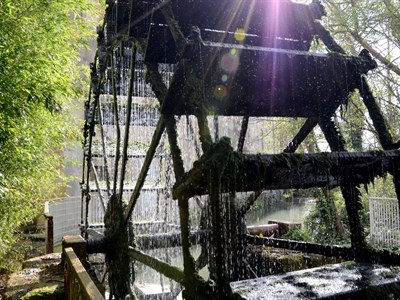
VAUCLUSE (84) – À l’origine, la plaine de Sorgues est un vaste marécage, gorgé des eaux provenant de Fontaine de Vaucluse, source de la Sorgue. Dès l’époque gallo-romaine, l’homme tente d’assainir et d’aménager cette terre afin de pouvoir s’y installer et cultiver.
Le canal de Vaucluse, creusé vers 900, permet d’assécher les terres marécageuses et de développer la cité. De 900 à 1200, le profil en long du canal est modifié pour créer des chutes d’eau, augmentant la force motrice de l’eau.
A farm used for agricultural, sanitary, and then industrial purposes.
The Vaucluse Canal and its Griffon branch irrigate agricultural fields: olive trees, vines, wheat, mixed grain, and fodder. Later, the water is used to water mulberry trees and raise silkworms. The canals also supply the town's fountains, distributed throughout the neighborhoods and used for domestic purposes (laundry, washing dishes, etc.).
Until 1907 and the establishment of the public water network, old Sorgues was equipped with seven public fountains fed by the springsof L'Orme and two collection galleries. There were also eight fountains, supplied by non-potable water from the Griffon Canal, which was sometimes used for drinking despite the prohibitions and risks of disease. The springs have practically dried upduring periods of drought. The inhabitants of Sorgues then obtain their water from the two public pumps on Avenue d'Orange and from a few private wells.
Taking advantage of this abundant, non-calcareous water, manufacturing plants began to develop in the 13thcentury century with the construction of wheat mills.
Au 14ème siècle, s’installe une première papeterie, suivie d’une autre, 100 ans plus tard, ainsi que plusieurs moulins à fouler les étoffes, des filatures de soie, un martinet à poudre. Au 19ème siècle, les roues à aubes se multiplient sur les canaux et leurs dérivations traversant la ville, alimentent laminoirs à cuivre, moulins à huile, minoteries, filatures de soie, amidonnerie, fabrique de pierres à aiguiser, usines à garance, fabrique de carbonate de soude (usine du Griffon).
visite libre, Balade dans la ville