An organization dedicated to mills
The Federation of French Mills
An association totally dedicated to mills
The mill: twenty-four centuries at the heart of European cultural identity
For at least 2,348 years, mills have occupied a unique and fundamental place at the heart of European history. Mills and millers are at the crossroads of economics and industry, occupying an absolutely central position. No other craft or industrial building, no other profession has ever been the source of such broad social consensus and so much admiration and jealousy. This place of transformation and its operator, despite their lesser place in our society, continue to haunt our imagination and our social history. The Fédération Des Moulins de France, faithful to this adventure, is fighting to preserve this heritage and give it a modern future. At the dawn of the 21st century, the mill, a user of renewable energy, still represents modernity at the heart of our lives.
The Fédération Des Moulins de France (FDMF) was founded on Sunday, March 24, 2002, in Nieul-sur-l'Autise (Vendée), on the initiative of representatives from twenty regional and departmental associations. It was registered under number 0851004885 at the Fontenay-le-Comte Sub-Prefecture. It is a non-profit association governed by the law of July 1, 1901. Its headquarters are located at the Town Hall of La Ferté-sous-Jouarre. It brings together independent associations, also governed by the law of 1901, whose main purpose is the study, preservation, defense, restoration, promotion, and sustainability of windmills, watermills, carousels, wind turbines, and all movable and immovable property related to their operation. It brings together regional, departmental, and local associations, as well as public and private organizations throughout metropolitan France and its overseas territories, individual members from France and Europe, and businesses.
The loyalty of the founders
The current team of administrators is supported by four honorary presidents, Solange Mary, André Desvallées, Phillipe Borgella, and Marc Léchelle, who, in addition to the services they have rendered to the preservation movement we represent for many years, continue to provide valuable advice to the current administrators.
Solange Mary has held positions of responsibility at the national level for more than twenty years: treasurer and then head of the College of Individual Members.
André Desvallées, Honorary General Curator of Heritage, who took over from Georges-Henri Rivière (1966), is the guardian of the history and development of the mill awareness movement at the national level.
Marc Léchelle has also been one of the longest-standing defenders of this heritage for fifty years.
Philippe Borgella, meanwhile, stepped down in 1999 after masterfully leading the movement following André Desvallées.
Broad and ambitious goals:
- Bringing together and supporting associations.
- Lobby public authorities, particularly ministries responsible for culture, education, the environment, tourism, infrastructure, industry, research, and agriculture, to promote and preserve mills.
- Organize events that facilitate meetings and exchanges of information and experiences on the subject.
- Organize events that reach the widest possible audience, such as European Mills and Milling Heritage Days, held on the third weekend in May.
- Advise and assist those who wish to carry out high-quality restorations and bring them to life.
- Coordinate research on mills.
- Participate in international conferences on topics related to the artisanal, industrial, and technical heritage represented by mills.
- Build up a collection of documentation on mills.
- Organize the preservation of skills that contribute to the preservation of mills
- Publish, encourage, and support the publication of all works concerning mills.
- Organize and support conferences on all topics related to mills.
- Represent associations at national and international events
- Encourage and support the creation of new local, departmental, and regional associations in areas that do not have them.
- Offer study trips focusing on mills in France and abroad.
- Publish a leading quarterly magazine in full color: Le Monde des Moulins.
- Offer a modern future for small mills by supporting the development of suitable equipment that enables the energy recovery of micro-waste.
A team of connoisseurs
The board of directors is made up of passionate individuals and resource persons.
Some are external to the board. Indeed, we have expertise in technical, mechanical, architectural, historical, and sociological fields. Some directors are also authors of scientific works that are references at the national and international level. They publish articles and specialized books on the subject of mills. All of them contribute their enthusiasm, offer specific advice, and share and pool their knowledge and expertise to preserve and promote the mills of our country. They form a team that is unique in France!
The board team pursues a policy of partnership with other federations and foundations working in the field of heritage preservation.
Its openness to Europe and the academic world gives it the status of an essential partner for administrations, local authorities, mill owners, and citizens who are keen to preserve mills, make them known to the widest possible audience, and turn them into driving forces for the tourist, economic, and human development of our country.
European Mills and Heritage Days Meulier
Launched in June 1995, National Mill Day was held on the third Sunday in June. Since 2008, this event has been held on the third weekend in May in partnership with the European association Moleriae under the name European Mill and Milling Heritage Days.
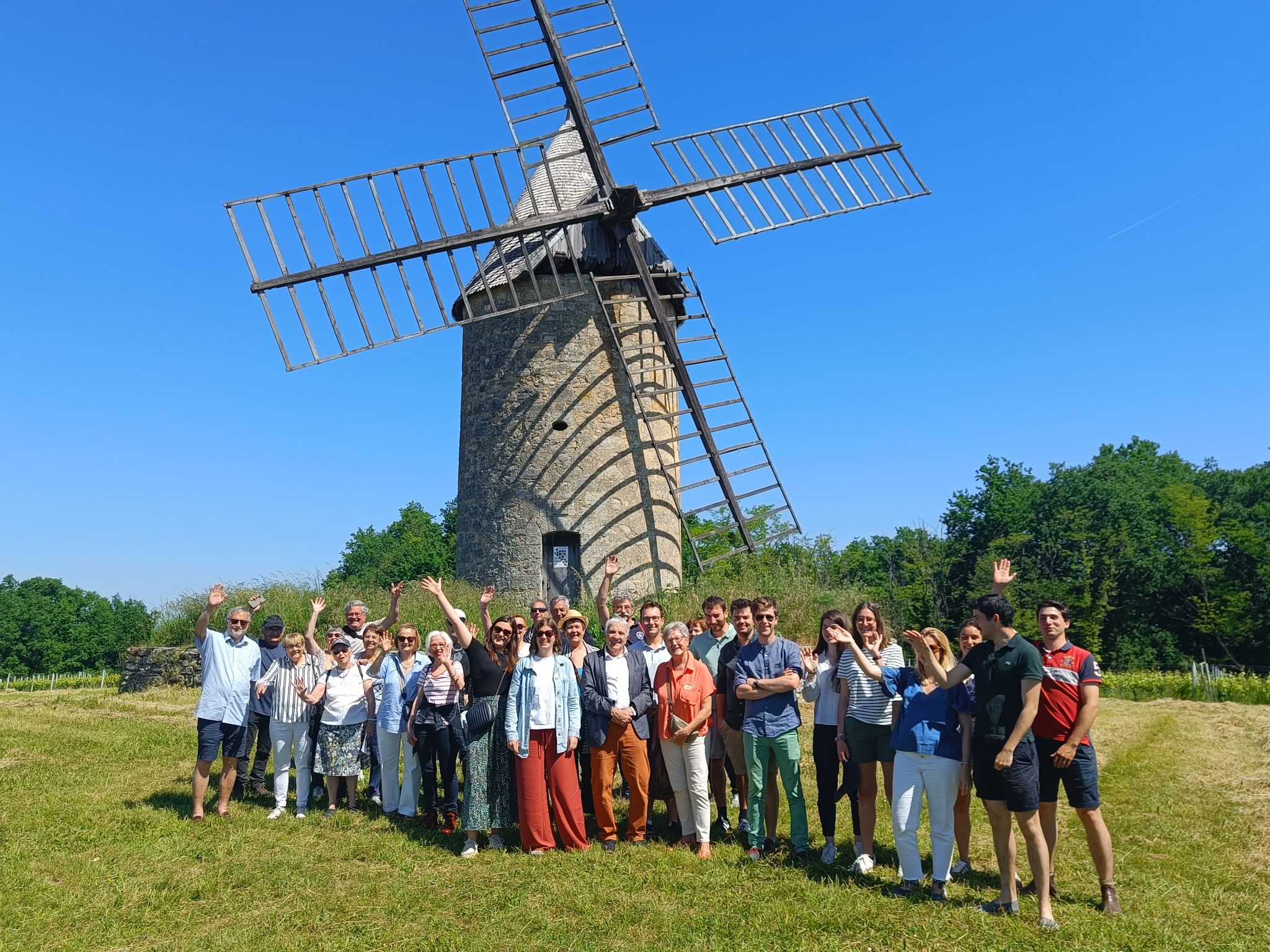
Mill owners (private, public, and associations) open their mills to the public and organize activities, celebrations, and demonstrations for the occasion.
Each year, the Fédération Des Moulins de France publishes an original poster to announce the event. Specially created for this event, it is offered to participants at a modest price. Each association communicates the programs and tours to the Departmental Tourism Committees. The departmental, regional, and national media give it wide coverage.
The European Mills and Milling Heritage Days aim to promote mills and the skills associated with them, and to pay tribute to the many volunteers who work to bring mills back to life in a sustainable way.
The mill is an amazing piece of heritage at the heart of human life:
- a wide variety of architectural styles
- A simple, clever, ingenious machine and mechanisms, both different and identical from one region to another.
- Expertise
- Engines using three natural and renewable forces, namely: hydraulic power, wind energy, and muscle power.
- Hydraulic sites integrated into the river environment for over twelve centuries
- An astonishing variety of over 130 different mechanisms used to crush, grind, blow, beat, pound, cut, tread, shred, mix, knead, polish, mill, turn, roll, chop, grate, pierce, irrigate, pump... in the countryside and in the city.
The origin of the mill
For now, the oldest documented mills date back to 348 BC. The Barbegal mill in the town of Fontvielle in the Bouches-du-Rhône department is a fine example of the existence of mills in the Gallo-Roman period (3rd-4th century AD). Writings have been found referring to windmills at the end of the 12th century. From the Middle Ages to the French Revolution, there was a period of rapid diversification in the types of mills in use. In the 19th century, it is estimated that there were more than 100,000 mills (between 800 and 1,800 mills per department). These were flour mills and a large number of industrial mills. It was also in France in the 19th century that the hydraulic turbine was invented and the world's first hydroelectric plant (la houille blanche) was installed.
Mills in France today.
How many mills remain today? No one can say for sure. Efforts are underway throughout France to restore their cultural identity. Some sites are enjoying a second life. Equipped with suitable machinery, the power of water is used to generate electricity for domestic use, or in some cases to produce walnut or olive oil, cereal flour, fabric, paper, or to saw wood. In all cases, a restored mill must be in regular operation. A mill that does not operate deteriorates very quickly, swallowing up all the efforts invested in its restoration.
Still too few mills restored!
While a number of pioneering regions have a significant number of restored mills, many others remain undervalued. Local authorities cannot bear the burden of this task alone. The Fédération Des Moulins de France (French Mill Federation) is able to support them in this endeavor.
Our website provides free access to a national map inventory (more than 760 sites listed), hundreds of articles and documentary resources, a bibliographic collection, and more.